
One of the key aspects of determining what level of risk icing has for a particular aircraft / system is to establish where and how quickly ice accretes. AeroTex has a variety of simulation tools to do exactly that, both in 2D and 3D. Whether it is a simple, straight wing at low speed, a complex 3D geometry or a propeller or rotor, we can calculate the water impingement, heat transfer and resultant ice shape. We have decades of experience both developing and applying codes, and we understand the benefits and potential pitfalls of different analysis methods. Whilst we participate in many research activities, our focus has always been on developing robust and efficient analysis techniques which can be used by industry. Compared to many people developing codes, we have practical experience in icing wind tunnel and flight testing and also in helping to develop actual products. It makes a difference when you have an understanding of the real-world implications of your analysis.
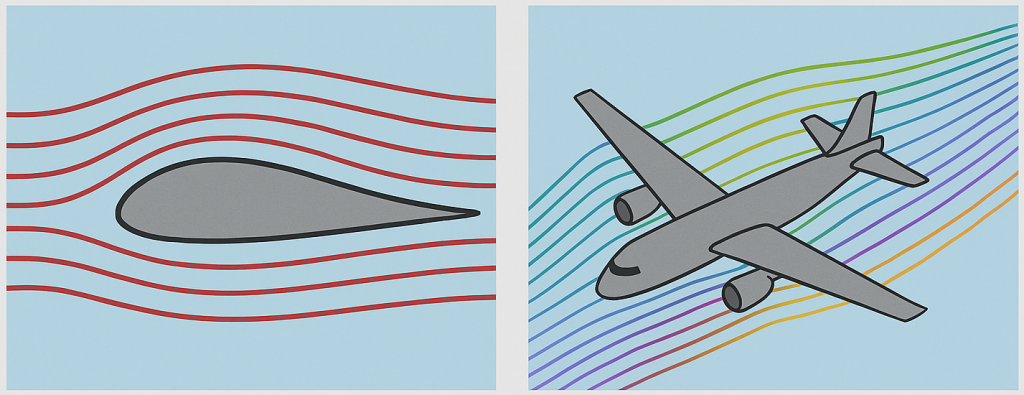
3D analysis has become the standard for aerodynamics in the aerospace industry. Why, then, do we continue to develop and apply 2D methods? In short, because they work! There are a wide variety of situations where 2D analysis still has enormous benefits, mainly due to the very low computational cost. For wings without significant sweep, and even on rotors and propellers, 2D analysis can give accurate answers in a fraction of the time needed to develop 3D solutions. This is particularly important where a high number of flight and icing conditions need to be assessed.
Of course, there are times when 2D analysis is simply not representative, and 3D simulations are needed no matter the computational cost. We recognise the overall benefit in a 3D workflow and have been working hard to ensure that our 3D capability matches the robustness of our 2D capability, whilst also putting maximum effort into minimising the time needed to perform the simulations.
By having such a deep understanding of the physical problem, we can help our customers determine whether 2D or 3D analysis is most suitable for their needs, thereby ensuring that they get the answers they need with minimum time and cost.
Aerodynamic Flowfield
Before any form of icing analysis can be performed, the aerodynamic flow must be understood and properly chracterised. Each step of the analysis process is important in obtaining an accurate ice shape.
In 2D analysis it is often sufficient to utilise a relatively low order solver, such as a potential panel method, in order to provide the velocity field. The geometry set-up for such cases is simple, only requiring a suitably fine set of (x,y) ordinates to define the aerofoil shape. From this, the velocity at any off-surface point can be determined, along with the surface pressure coefficient (Cp) distribution. AeroTex utilises the TAC2 code for this process.
3D analysis generally requires a much more time-consuming process of defining a surface and volumetric mesh, including a boundary layer.